The Framework
The five dimensions
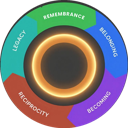
Remembrance, Belonging, Becoming, Reciprocity, and Legacy — five dimensions of relational leadership. Each names a wisdom tradition as inspiration, not ownership, and keeps professional coaching boundaries.
Overview
Select a segment to preview each dimension, then read the full detail below.
On this page
Each dimension follows the same template: central question, what it examines, coach stance, client inquiry, relational consideration, organizational applications, sample coaching questions, potential areas for inquiry, ethical guardrails, and a cultural stewardship note. Organizational applications are illustrative possibilities, never guaranteed outcomes.
The five dimensions in detail
Each of the five dimensions of Ubuntu Roots Coaching™ names a distinct territory of relational leadership development. Together they form a complete arc: a leader who knows what they carry (Remembrance), knows who they are accountable to (Belonging), is growing in ways their community can recognize (Becoming), gives as well as receives (Reciprocity), and thinks in generational rather than quarterly time (Legacy). The detail below shows how a community-centered coaching framework turns each territory into a live coaching conversation — with explicit ethical guardrails at every step.
What did your people know that you have been taught to forget?
What this dimension examines
Personal and collective memory: the values, stories, gifts, and patterns a leader inherits from family, culture, place, and formative communities — and which of them to carry forward, revise, or set down.
Coach stance
Holds an ancestral mirror — reflecting lineage, inherited gifts, stories, and patterns back to the client without making clinical, historical, or spiritual claims, and without treating ancestry as destiny.
Client inquiry
The client leads the inquiry into inherited values and narratives, deciding for themselves what is theirs to keep, question, or release. Nothing about family or culture must be disclosed.
Relational / community consideration
Community may serve as a living archive — elders, peers, family systems, mentors, or trusted stakeholders offering perspective — only when voluntary, ethically appropriate, consent-based, and governed by confidentiality.
Organizational applications (illustrative)
- Organizational memory and founder narratives
- Institutional identity and inherited leadership patterns
- Articulating institutional values
Sample coaching questions
- Which inherited values still serve your leadership — and which were handed to you without your consent?
- Whose story are you continuing, and whose are you quietly revising?
- What did an earlier generation in your family or field understand that your current context overlooks?
- What would you like to carry forward, and what feels ready to set down?
Potential areas for inquiry
- Whether reflecting on inherited values changes how a leader frames present decisions
- How memory work relates to a leader's sense of continuity and identity at work
Ethical guardrails
Avoid treating ancestry as destiny, assigning cultural identity to a client, engaging in trauma treatment, or pressuring anyone to disclose family or cultural material.
Cultural stewardship note
Draws inspiration from the Akan Sankofa tradition (Ghana) — “It is not wrong to go back for what you forgot.” Named as a point of inspiration, not something Ubuntu Roots Coaching™ owns or represents.
Who do you belong to — and who belongs to you?
What this dimension examines
The client's web of relationships — where they are nourished, disconnected, overextended, or depleted — and how their leadership behaviour shapes belonging for others.
Coach stance
Attends to relational wholeness: the patterns in how the client gives and receives care, trust, feedback, recognition, and accountability, while preserving the client's autonomy.
Client inquiry
The client maps their own relationships and names where connection is strong or strained. Disclosure to any third party is never required.
Relational / community consideration
Community may provide feedback, counsel, stakeholder insight, or reflective mirrors — when appropriate, voluntary, and governed by confidentiality agreements. It is a relational context for inquiry, not an automatic participant.
Organizational applications (illustrative)
- Trust and collaboration
- Inclusion and team cohesion
- Stakeholder relationships
Sample coaching questions
- Where in your web are you nourished, and where are you quietly overextended?
- Who experiences more belonging because of how you lead — and who experiences less?
- What do you consistently give that you rarely allow yourself to receive?
- Which relationship, tended honestly, would change the most for you this season?
Potential areas for inquiry
- How leaders describe changes in relational awareness over an engagement
- Whether attention to belonging shifts how a leader gives and receives feedback
Ethical guardrails
Preserve client autonomy; never require disclosure to a community; avoid group pressure, coercive accountability, or assumptions about family or community norms.
Cultural stewardship note
Informed by Ubuntu / Nguni Bantu philosophy (Southern Africa) — “I am because we are.” Personhood understood as constituted through relationship. Referenced with respect, without claim of ownership or authority.
What must you release so the next version of you can take root?
What this dimension examines
Developmental edges: values-based choices, fears, assumptions, false identities, competing commitments, and an emerging sense of purpose.
Coach stance
Holds the productive tension between who the client is today and who they are becoming, remaining non-directive and honouring the client's agency and pace.
Client inquiry
The client names what they are outgrowing and what they are moving toward, choosing their own direction. The coach does not prescribe an outcome.
Relational / community consideration
Community may bear witness to change, recognize new leadership behaviour, and support accountability — when invited and appropriate.
Organizational applications (illustrative)
- Leadership transitions and succession
- Role evolution and adaptive leadership
- Clarifying purpose
Sample coaching questions
- What identity served you well once and now quietly limits you?
- What are you being asked to release, and what makes releasing it hard?
- If the next version of you were already here, what would they stop doing?
- What commitment are you holding out of habit rather than conviction?
Potential areas for inquiry
- How leaders articulate developmental edges before and after an engagement
- What conditions help a leader move through a period of role change
Ethical guardrails
Do not recreate, commercialize, or simulate sacred ceremonies. Coaching practice remains distinct from spiritual rites and claims no authority over any tradition.
Cultural stewardship note
Draws respectful inspiration from Lakota vision-quest traditions — referenced without imitation, appropriation, or ceremonial replication, and without claim to represent the tradition.
What does this land — this team, this organization — need from you right now?
What this dimension examines
How the client stewards power, resources, influence, decision rights, recognition, opportunities, and the systems around them.
Coach stance
Holds a covenant of mutual flourishing: helping the client consider whether their leadership generates trust, opportunity, and sustainability for others — without imposing a moral or political agenda.
Client inquiry
The client examines their own stewardship and its effects, leading the reflection while the coach helps surface stakeholders, consequences, and systems.
Relational / community consideration
The community's wellbeing and feedback can become part of the client's reflection on leadership impact, where consented and appropriate.
Organizational applications (illustrative)
- Power stewardship and resource allocation
- Decision-making and stakeholder impact
- Mutual accountability
Sample coaching questions
- Where does your leadership currently generate life for others, and where does it extract it?
- What are you receiving from this system that you have stopped returning?
- Whose flourishing depends on a decision only you can make right now?
- What would balanced give-and-take look like with the team you lead?
Potential areas for inquiry
- How leaders describe their stewardship of power and resources over time
- Whether reflecting on reciprocity changes how decisions account for stakeholders
Ethical guardrails
Avoid imposing a moral or political agenda. Support client-led inquiry while helping the client weigh stakeholders, consequences, and systems.
Cultural stewardship note
Informed by Andean Ayni and Quechua traditions of reciprocity (Peru and Bolivia) — giving and returning. Named as inspiration, not ownership or equivalence.
What will the children of your children's children say you stood for?
What this dimension examines
The inheritance a leader intends to leave: how present decisions align with long-term impact, and what people, systems, and practices will continue after them.
Coach stance
Holds the long arc — inviting the client to consider future impact without prescribing any particular legacy.
Client inquiry
The client defines their own long-horizon intentions; the coach neither assigns a legacy nor claims that all communities share one view of intergenerational responsibility.
Relational / community consideration
The community can be a potential beneficiary and continuation of the client's leadership legacy — considered reflectively, not obligated.
Organizational applications (illustrative)
- Succession and sustainability
- Culture stewardship and institutional continuity
- Long-term impact
Sample coaching questions
- What decision today would still matter in twenty years — and to whom?
- What are you planting that you may never see reach full growth?
- What would you like to be true long after your role has passed to someone else?
- Which short-term win are you tempted by that a long horizon would question?
Potential areas for inquiry
- How leaders describe long-horizon thinking in relation to present decisions
- Whether legacy reflection changes how succession or continuity is approached
Ethical guardrails
Avoid essentializing any tradition or claiming that all communities share one view of intergenerational responsibility.
Cultural stewardship note
Draws inspiration from Haudenosaunee Seven Generations thinking — presented carefully as inspiration for long-horizon responsibility, not as a generalized or decontextualized doctrine.