Coaching in Practice
How an engagement unfolds
Ubuntu Roots Coaching™ is applied through a clear, consent-based journey. Everything below is illustrative: real engagements are shaped by the client's context, choices, and agreements.
A typical engagement journey
An engagement generally moves through eight stages. The sequence is a guide, not a prescription, and community or stakeholder input appears only where explicitly invited.
Discovery and fit assessment
Explore goals, context, and whether the approach fits — with no obligation to proceed.
Coaching agreement and ethical boundaries
Set agreements on scope, confidentiality, consent, and referral before any deeper work.
Context and stakeholder mapping
The client maps the systems and relationships relevant to their leadership.
Priority dimension selection
The client chooses which dimension matters most in this season.
Coaching sessions and reflective practices
Client-led sessions using reflective inquiry and, where useful, illustrative methods.
Optional consent-based community or stakeholder feedback
Only when explicitly agreed, voluntary, and governed by confidentiality.
Learning integration and leadership experiments
Translating reflection into small, self-chosen experiments in real leadership.
Reflection on impact, sustainability, and legacy
Considering longer-horizon effects and what should continue.
Coaching formats
One-to-one executive coaching
Individual work with a senior leader on relational, developmental, and stewardship questions.
Leader transition coaching
Support through role change, onboarding, or succession.
Team and leadership-cohort coaching
Shared inquiry across a leadership team or cohort, with clear confidentiality boundaries.
Culture and organizational-development engagements
Applying relational questions to culture and organizational change, adapted to context.
Coach education and practitioner development
Preparing coaches to work with the framework ethically and with cultural humility.
Research or pilot-based implementation
Structured, ethically governed pilots designed for study and learning.
Sample practice methods
Illustrative, not mandatory. These methods are options a coach and client may draw on. None is required, and each is adapted to the client's context and consent.
Relational map
A client-drawn map of relationships and where connection is strong, strained, or depleted.
Legacy horizon reflection
Considering long-term impact and what the client hopes will continue.
Stakeholder-impact inquiry
Exploring how leadership decisions land on the people and systems they touch.
Values and memory narrative
Reflecting on inherited values and which to carry forward, revise, or set down.
Leadership stewardship inventory
Reviewing how power, resources, and opportunity are stewarded.
Consent-based feedback circle
A voluntary, agreed feedback practice governed by confidentiality.
Community-impact reflection
Considering the client's effect on the wider relational field, reflectively.
Seasonal learning review
A periodic review of what has grown and what wants attention next.
Example case vignette
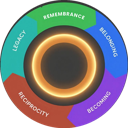
This vignette is illustrative and fictional. It does not describe a real client and claims no results. It shows only how the five dimensions might inform coaching questions and experiments.
A fictional division head, “Maya,” is preparing to hand over leadership of a team she has led for a decade while the organization reshapes its culture. Across an engagement, the dimensions might inform inquiry like this:
- Remembrance
- Which inherited leadership patterns does Maya want to carry into the handover, and which is she ready to set down?
- Belonging
- Where in her team is belonging strong or strained, and how does her way of leading shape it?
- Becoming
- What identity as “the person who holds it all” might she release so her successor can take root?
- Reciprocity
- What does the team need from her now — and what is she receiving that she could return through a fair handover?
- Legacy
- What does she hope will still be true of the team long after she has moved on, and what small experiment could plant that seed?
Any actual stakeholder involvement — for example, a consent-based feedback circle with her team — would occur only if Maya explicitly chose it and it were governed by clear confidentiality boundaries.