Research and Evaluation
Research, evaluation, and learning agenda
Ubuntu Roots Coaching™ is presented as a framework for inquiry. It invites independent assessment of its conceptual coherence, feasibility, acceptability, cultural responsiveness, implementation conditions, and the questions it raises for leadership and relational practice.
Research Question Evidence Under Development
Why study this approach?
- The need to examine relational and community-centered approaches to leadership development
- The importance of culturally responsive coaching models
- The opportunity to explore how coaching can attend to the individual, relationships, organizational systems, and long-term leadership impact
- The need to study both potential benefits and potential risks
The framework requires independent validation before efficacy claims can be made. The questions below are offered as starting points for that work.
Where this framework sits in existing scholarship
Ubuntu Roots Coaching™ did not emerge from a vacuum, and it does not claim to. It addresses questions that are already alive in several well-established bodies of research — and it is offered in dialogue with them, not as a replacement for them.
- Relational leadership theory (Uhl-Bien, 2006) examines leadership as a social process of organizing rather than a set of individual traits. Ubuntu Roots Coaching operationalizes that idea inside a coaching conversation: the client is never developed in isolation from their relationships, community, and institution.
- Ubuntu in management and organizational scholarship (Mbigi & Maree, 1995) brought Southern African relational philosophy into the study of organizations. This framework names that lineage openly — and, through its cultural stewardship commitments, declines to treat ubuntu as a brand asset rather than a living tradition.
- Servant and stewardship leadership research (Greenleaf, 1970) asks whose interests leadership ultimately serves. The Reciprocity and Legacy dimensions carry that question into executive coaching: what does a leader owe, to whom, and over what time horizon?
- Evidence-based coaching research — the field that has spent two decades asking what makes executive coaching effective, for whom, and under what conditions — is the community this page is written for. Every research question below is an invitation to that community, in the open.
References: Uhl-Bien, M. (2006), The Leadership Quarterly; Mbigi & Maree (1995), Ubuntu: The Spirit of African Transformation Management; Greenleaf, R. K. (1970), The Servant as Leader.
Proposed research questions
- How do participants describe the acceptability, relevance, and psychological safety of Ubuntu Roots Coaching™?
- Which components are most feasible in executive, organizational, educational, or community contexts?
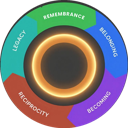
- How do coaches operationalize the five dimensions consistently while adapting to context?
- How does the model relate to the quality of leadership reflection, relational awareness, stewardship orientation, and legacy thinking?
- What ethical, cultural, confidentiality, or implementation challenges arise?
- How do stakeholders experience consent-based involvement when such involvement occurs?
- How does this framework compare with more individual-centered coaching models in terms of perceived relevance, process, and experience?
- What coach preparation, supervision, and fidelity supports are needed?
Potential study designs
Options, not prescriptions:
Conceptual analysis and expert-panel review
Participatory design research
Qualitative interviews and thematic analysis
Feasibility and acceptability pilot studies
Mixed-methods studies
Pre/post exploratory coaching studies
Comparative process studies
Case-study research
Implementation and fidelity research
Longitudinal leadership and organizational-learning research
Suggested measures and data sources
Categories only; no proprietary instruments are named. Selection and validation would be the work of independent researchers.
- Client-reported coaching experience
- Psychological safety and perceived trust
- Relational leadership awareness
- Leadership self-efficacy
- Stakeholder or team feedback, where appropriate and consented
- Sense of belonging and connection
- Leadership stewardship behaviors
- Long-term orientation and legacy reflection
- Organizational climate or culture indicators
- Qualitative narratives, reflective journals, and interviews
- Coach fidelity and supervision notes, de-identified and ethically governed
Ethics and protections
- Informed consent
- Confidentiality
- Voluntary community and stakeholder participation
- Data minimization
- Culturally responsive research practices
- Clear scope-of-practice boundaries
- Referral pathways to qualified support
- Community consultation where relevant
- Institutional review board or ethics review where applicable
- Avoidance of extractive research
- Transparent governance of intellectual property and data ownership
Evaluation principles we commit to
Protections govern how participants are treated; these principles govern how Maturity.Coach, as steward of the framework, will behave as evidence accumulates.
- Independent validation first. No efficacy claims until independent, ethically governed studies support them — the framework currently makes none.
- Transparent reporting. Null and negative findings will be reported alongside positive ones, and study registrations or summary results will be published wherever partner agreements allow.
- Non-extractive research. Communities and participants contribute on informed, consented terms and share in whatever is learned.
- Open questions. The agenda is published here precisely so that people outside Maturity.Coach can challenge it, refine it, and extend it.
Data arising from any study is governed by the Research Participation & Data Governance policy.
Partnership invitation
We invite university labs, professional associations, doctoral researchers, and institutional partners to consider independent, transparent, ethically governed assessment of the framework.